
I recently picked up a physical copy of Vermis I, an interesting setting book whose core conceit is that it is a game manual for an old King’s Field-esque title that never got released. Besides absolutely dripping with nostalgia and chocked full of evocative art, it has a lot of cool ideas that I feel adapt well to playing games at the table. Following my entry into the 2023 One Page Dungeon contest I’ve been thinking about writing more material for my home table as opposed to adapting adventures and modules exclusively, and flipping through the pages of Vermis has given me a few ideas I’ve been thinking of moving forward with.
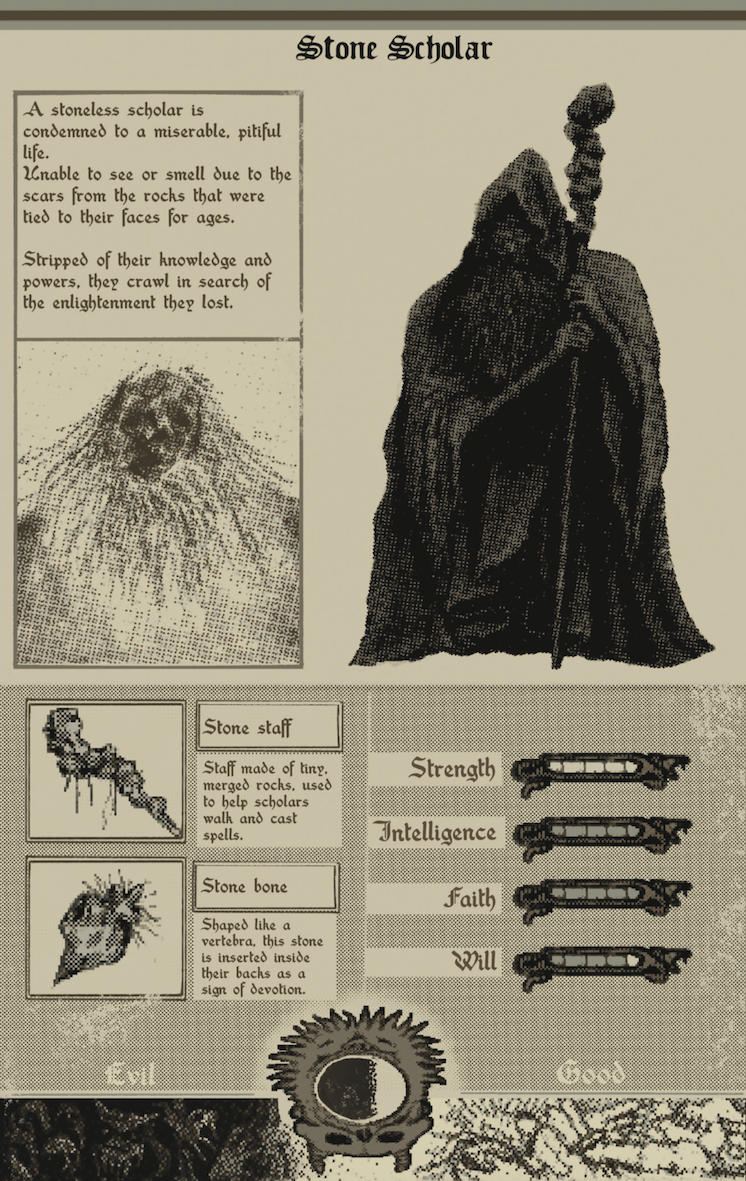
The art is absolutely gorgeous and is worth the price of admission alone. Of course art is subjective but the coarse and grainy style feels like it perfectly channels the energy of old game manuals. The vague and implicit setting really draws you in and the book opens with a two page spread of the different character origins – akin to the options you have for character creation in many of From Software’s fantasy games. Each has their own little blurb before the book opens into describing them in more detail, and the idea of using more colorful backgrounds for a TTRPG is one that I find particularly interesting. The character creation portion of Knave was very popular with the last group I played it with, and the more fleshed out backgrounds in Worlds Without Number were also a hit with a different group of players – providing an interesting opportunity to conceptualize your character during the creation process without locking you in to any particular role. The origins in Vermis pull more weight, which is both good and bad since they could also dictate what a player’s character should be like as opposed to giving them a rough idea, but they make up for this potential pitfall with sheer novelty and variety and I could see them working particularly well for something like an adventure path, curated sandbox module or one-shot.
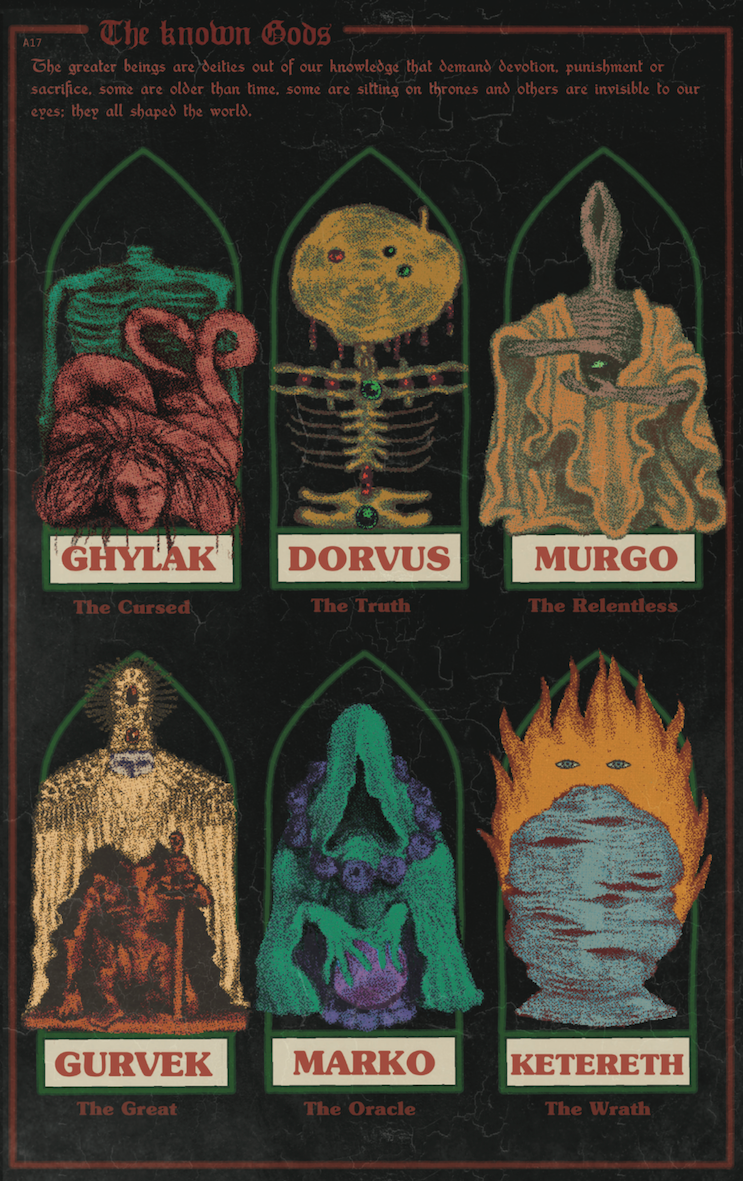
The following section on deities is short and provides little direct information but there’s a wealth of implicit detail about each god throughout the text, including earlier in the character origin section. This is a feature that I think works well in a book like Vermis, intended to be a loose setting primer and an inspiring read, but would definitely be a large negative in an adventure or module since it tries to surprise the reader instead of inform the GM. Still, the rest of the setting ties in well with this mentality, as many of the areas described in the text have direct connections with different character origins or deities, providing opportunities for character choice to make an impact during exploration. This is something I’d especially like to leverage in future works, as I’ve found players enjoy lore when it’s in the background and helps explain or contextualize events as opposed to being something more blatant, like a lore dump. Finding out that your choice of class, race or god provides you with additional information or options during play seems to be a motivating moment for players, especially since it’s framed as gaining something based on your initial choice, not losing it.
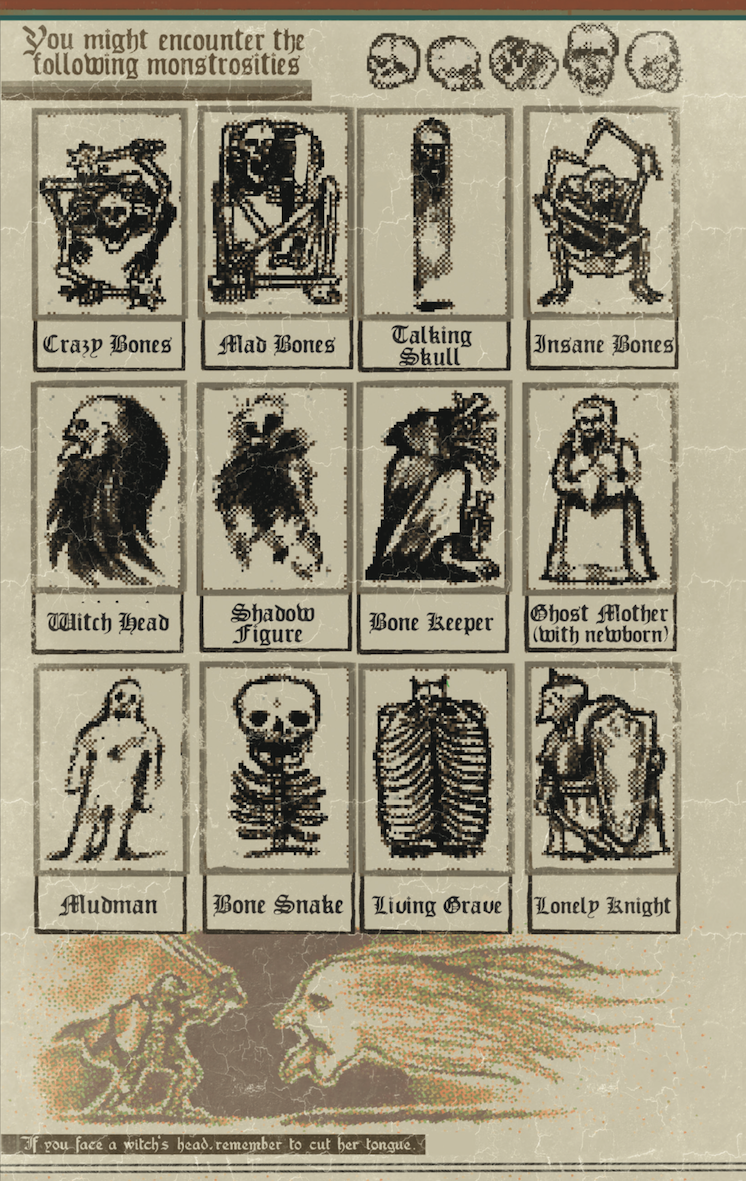
Much of the book is, of course, presented in a style more in keeping with the Souls series than something directly useful at the table (with NPCs addressing a singular “you” and lacking too much in the way of non-combat interaction) but I do think that Vermis has potential as a potential game supplement. Many of its ideas are mappable to tabletop play, and if nothing else the art and writing form a very coherent whole that really gets the brain juices flowing. For my part, I want to incorporate that feeling of dense lore existing just beyond the area of play similar to how the NPCs, areas and treasures of Vermis hint at a larger world that encourages engagement but still feels like it can’t be fully understood. Finding ways to incorporate player backgrounds and classes into the world proper seems to be one way to do it, and another is to make sure that each location, monster, quest giver or piece of treasure does more than simply push play forward – each element of the game should feed back into the setting and provide the players’ with an impetus to really dig into the fiction and immerse themselves in the game world a bit more.
 The Lady and Tiger
Leave a comment